
【Transcription】Earnings Results for the Fiscal Year Ended June 2026
-
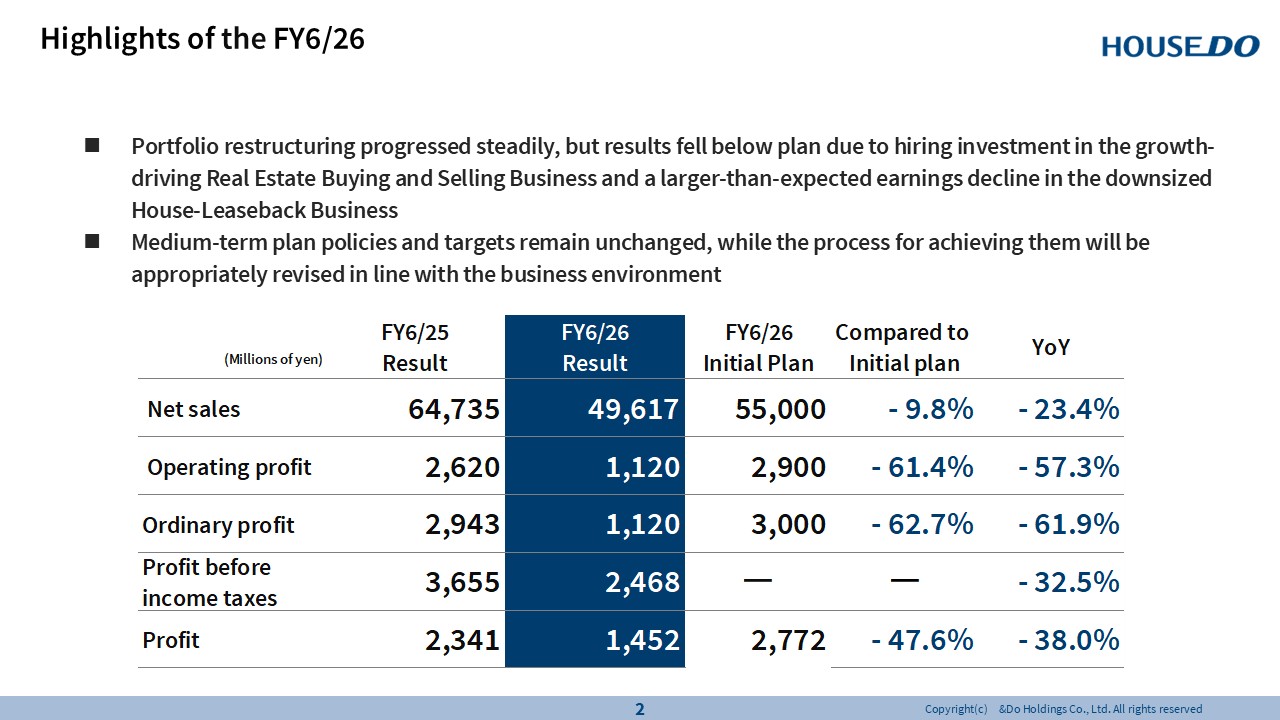
Highlights of the FY6/26
[Tomita:Vice Chiarman, CFO and CHO]We will now present the financial results of &Do Holdings for the fiscal year ended June 2026. Thank you for your attention.
First, in the financial results summary for the fiscal year ended June 2026, the most notable development, as we have already reported on a quarterly basis, was the substantial decline in net sales resulting from a major change in the economic environment, particularly the decline in HLB fund formation due to rising interest rates. This had a significant impact on the results for the fiscal year ended June 2026, resulting in lower net sales and profit.
The portfolio changes entailed additional costs, and it took some time to absorb them. However, by the end of the fiscal year ended June 2026, net sales had begun to recover strongly. If net sales remained low, there would be little reason for optimism about the future. However, they have been gradually increasing, so we believe the outlook is highly promising.
Regarding the medium-term management plan, we are not currently considering any changes to the target figures. We intend to manage the Company firmly toward achieving these targets while appropriately reviewing the process for doing so.
-
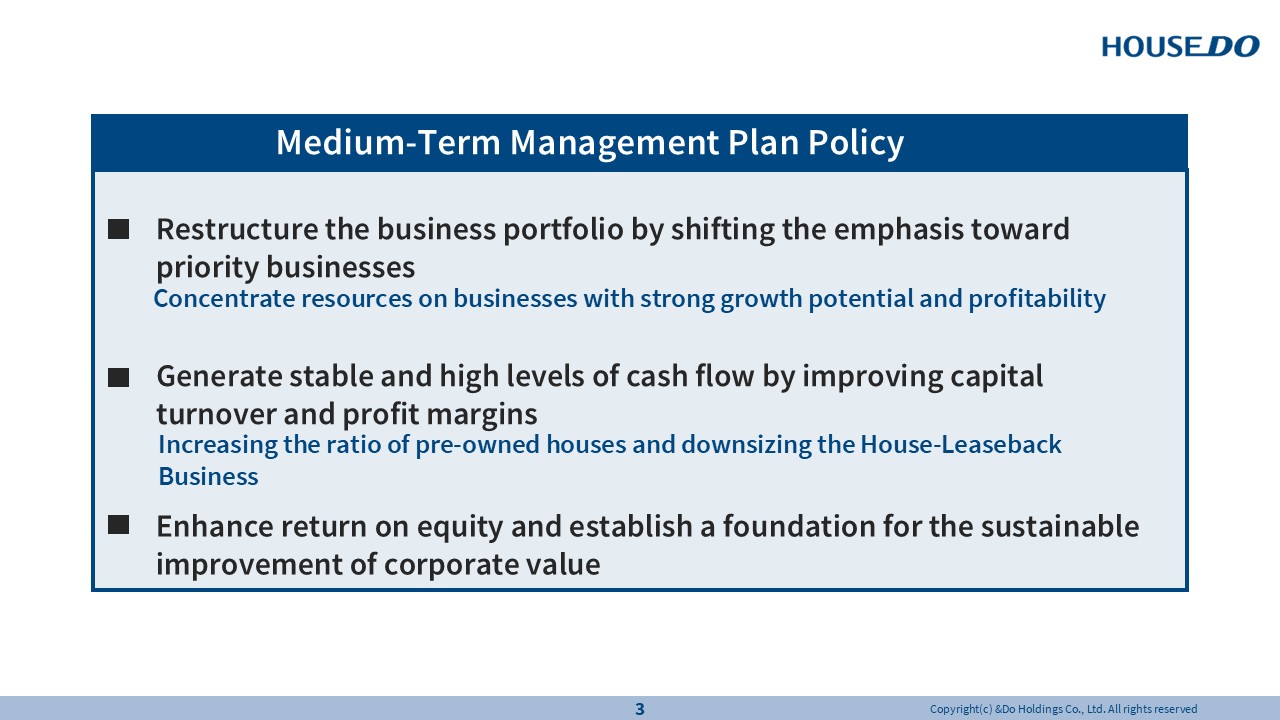
Medium-Term Management Plan Policy
We have set out three policies under the medium-term management plan. Specifically, we intend to restructure the business portfolio, improve capital turnover and profit margins, and enhance capital efficiency. In particular, we will firmly pursue improvements in return on invested capital (ROIC).
-
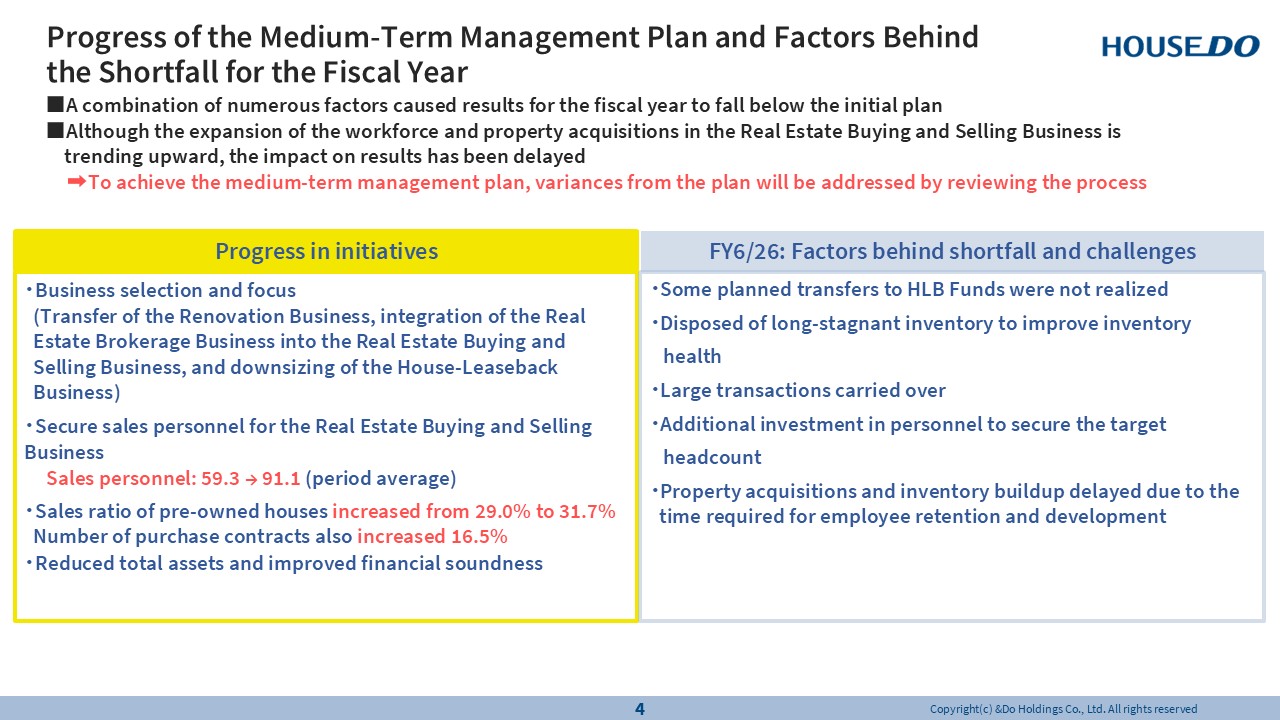
Progress of the Medium-Term Management Plan and Factors Behind the Shortfall for the Fiscal Year
Regarding progress under the medium-term management plan and the factors behind the failure to achieve the targets for the fiscal year under review, we have presented the measures that progressed and the outstanding issues. Regarding business selection and focus, we transferred the Renovation Business and integrated the Real Estate Brokerage Business into the Real Estate Buying and Selling Business. We will explain this later in the section on the Real Estate Buying and Selling Business.
We will also discuss securing sales personnel and the percentage of sales from pre-owned homes later. On the financial front, we reduced total assets and improved our financial soundness. This was not simply a matter of reducing total assets and raising the shareholders’ equity ratio. We implemented substantive management improvements with a focus on financial soundness, interest-bearing debt, and, particularly in promoting the Real Estate Buying and Selling Business, inventory turnover. The results are clearly reflected in the figures, and we will discuss the improvement in financial soundness in greater detail later.
As for the factors behind the failure to achieve the targets, as mentioned earlier, one major factor was that some of the planned transfers of House-Leaseback properties to HLB funds did not materialize.
-
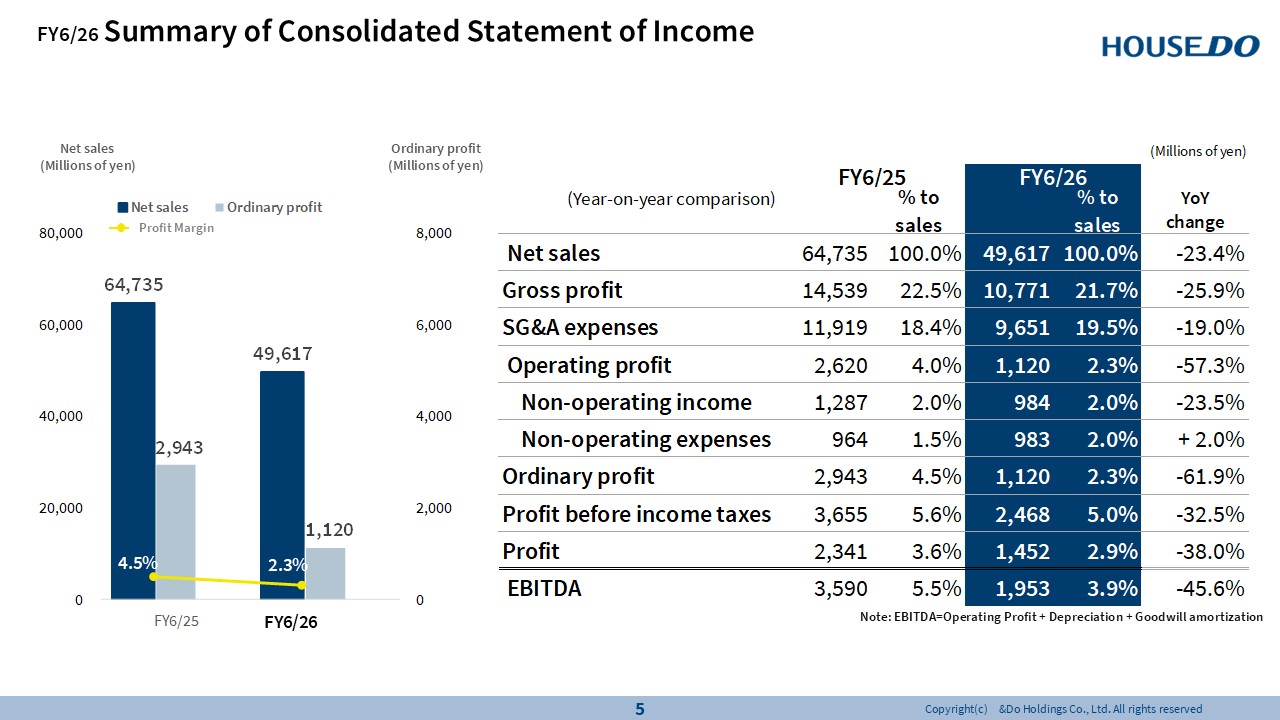
FY6/26 Summary of Consolidated Statement of Income
Next is an overview of the consolidated statement of income. As stated earlier, the fact remains that both net sales and profit declined. However, we ask that you understand that the top line has been steadily increasing. As costs were incurred upfront, operating profit decreased year on year and the operating profit margin also declined. However, as we increase the top line, we intend to secure both operating profit and an adequate operating profit margin.
Real estate remains at the core of our business. In particular, with regard to non-operating expenses, interest rates have recently been trending upward. Our focus is on efficiently procuring funds, making effective use of our own funds, and controlling interest expense. At present, there has been no major change from the previous fiscal year. We cannot allow rising interest rates simply to result in higher interest expense, so we intend to control interest expense appropriately, curb non-operating expenses, and increase the top line.
Profit declined for the fiscal year under review. The gain on the transfer of the Renovation Business was recorded as extraordinary income, resulting in a gap between ordinary profit and profit.
-
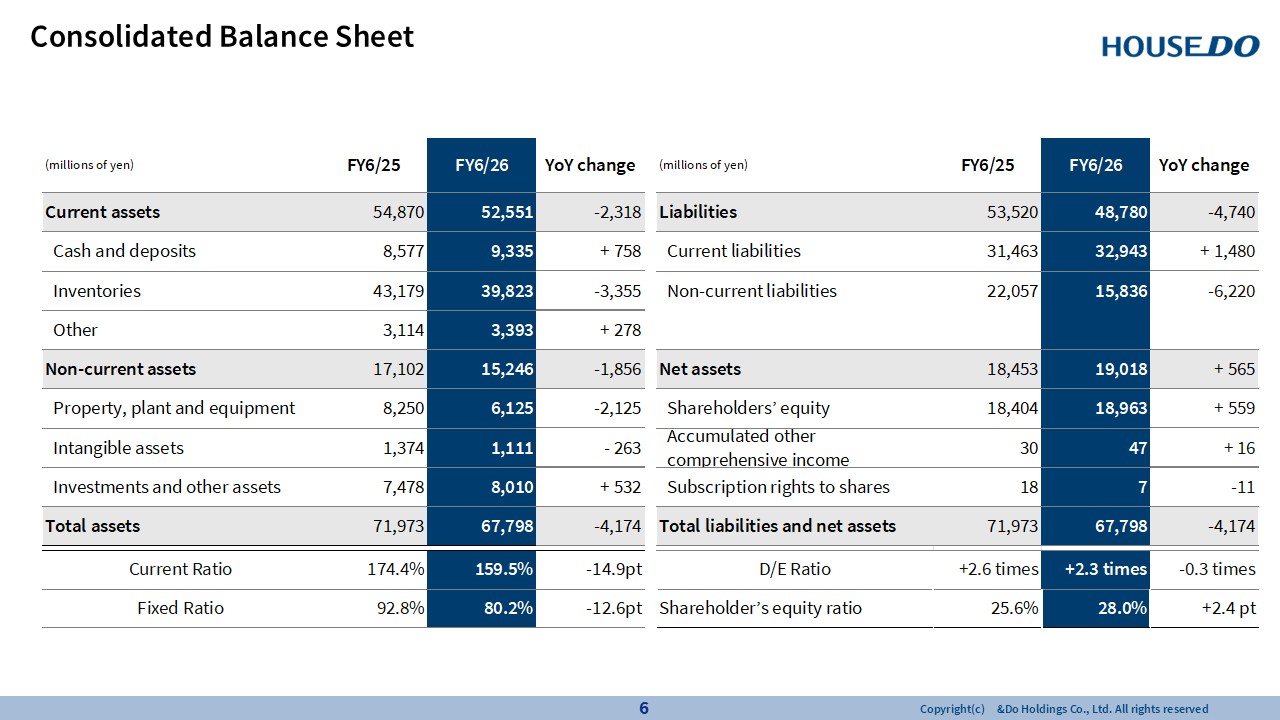
Consolidated Balance Sheet
Next is the consolidated balance sheet. As mentioned earlier, our aim was not merely to reduce total assets, but to ensure financial soundness, particularly with regard to inventories. Inventories also decreased by 3,355 million yen due to improved inventory turnover. We made a concerted effort to improve inventory turnover. We sold property, plant and equipment and reduced non-current liabilities, including a decrease of nearly 4 billion yen in long-term borrowings. This will reduce scheduled repayments associated with working capital financing. We will also use short-term financing for inventories, thereby managing and procuring funds efficiently while appropriately controlling interest expense, as mentioned earlier.
As a result, the shareholders’ equity ratio increased by 2.4 percentage points, from 25.6% to 28.0%. A ratio of 30% is generally considered a benchmark for financial soundness. Although net sales and profit declined, we are making substantial progress in securing the financial soundness of the balance sheet.
-
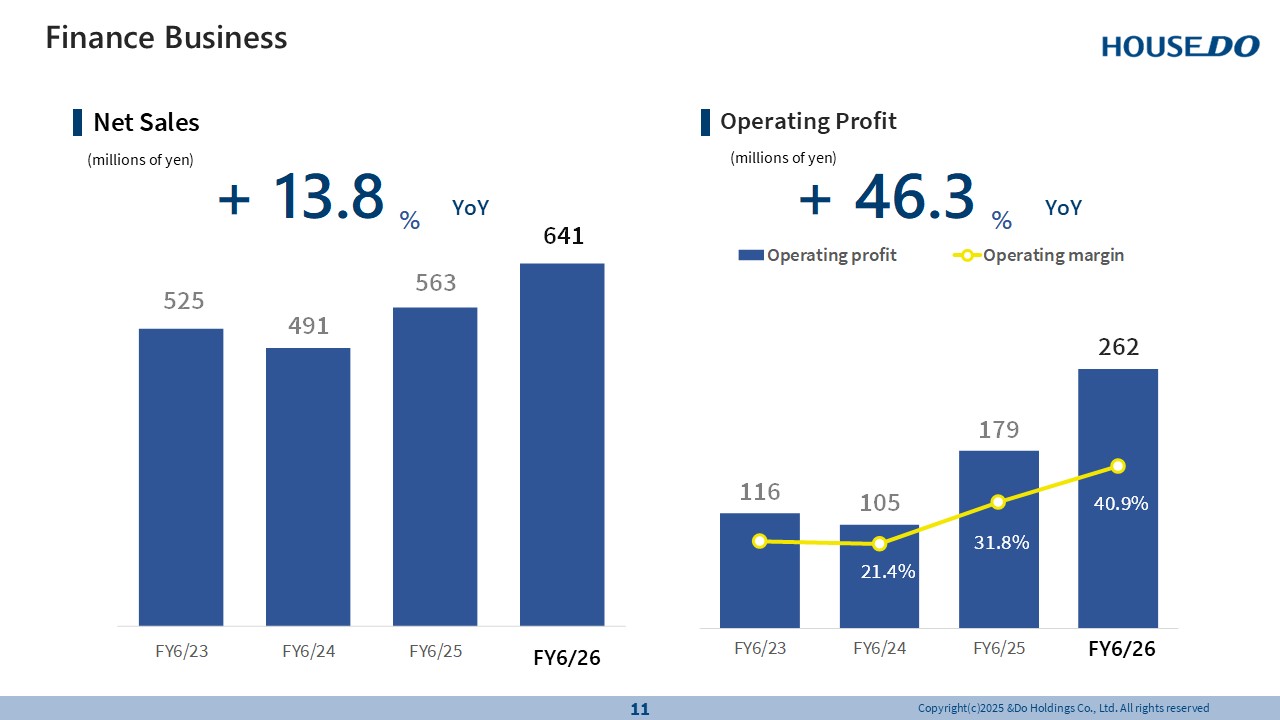
Finance Business
I will now explain the Finance Business segment. Thanks to your support, the outstanding balance of guarantees in the guarantee business has now reached 35 billion yen, and net sales have followed an upward trend over the past three fiscal years.
We previously operated a money lending business, but this has now been reduced to almost zero, and we are concentrating all our human, physical, and financial resources on the guarantee business. With all our efforts focused on this business, net sales increased by 13.8%, representing double-digit growth. Operating profit was 262 million yen, 2.5 times the level three years earlier.
The Finance Business is characterized by a very high operating profit margin, demonstrating the importance of scaling up the business.
-
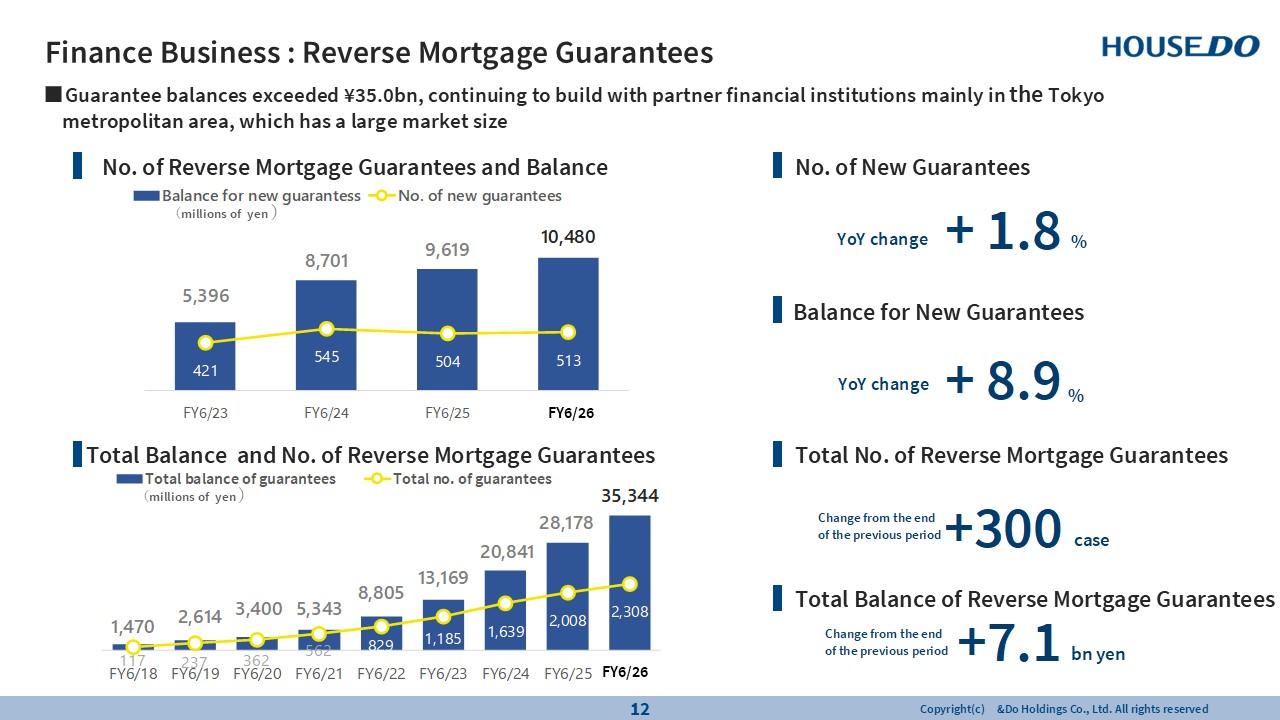
Finance Business : Reverse Mortgage Guarantees
Next is reverse mortgage guarantees in the Finance Business. With the cooperation of our partner financial institutions, the outstanding balance of guarantees surpassed 35 billion yen. Naturally, after 30 billion yen, our next targets are 40 billion yen and 50 billion yen. We will work closely with our partner financial institutions and increase the average amount per guarantee by also offering credit-line guarantees. We will seek to build up the guarantee balance primarily in the Tokyo metropolitan area, where the market is particularly large, and we are seeing a very encouraging response. Our aim is to secure a substantial outstanding balance of guarantees in large markets.
In addition, as mentioned earlier, we are focusing on expanding guarantees for business purposes, as these have a high average value. As a result, new guarantees were provided, increasing the cumulative number of guarantees by 300, while the total balance of guarantees increased by 7,160 million yen. The point to note here is that the balance for new guarantees was 10,480 million yen, while the total balance of guarantees increased by a net 7,160 million yen. The difference represents cancellations. As the guarantee balance grows, the number of cancellations also increases. However, because we are a real estate?based company rather than a financial-sector guarantee company, these cancellations will become a significant source of business.
Real estate transactions arising from these cancellations were approximately 250% of the previous fiscal year’s level, while the closing rate roughly doubled. We will create business opportunities through two business models: building up the outstanding balance of guarantees, and using the cancellations?the exit point of each guarantee?reflected in the gap between new guarantee volume and the net increase in the outstanding balance to generate real estate transactions. By combining these two business models, we intend to expand the Finance Business.
-
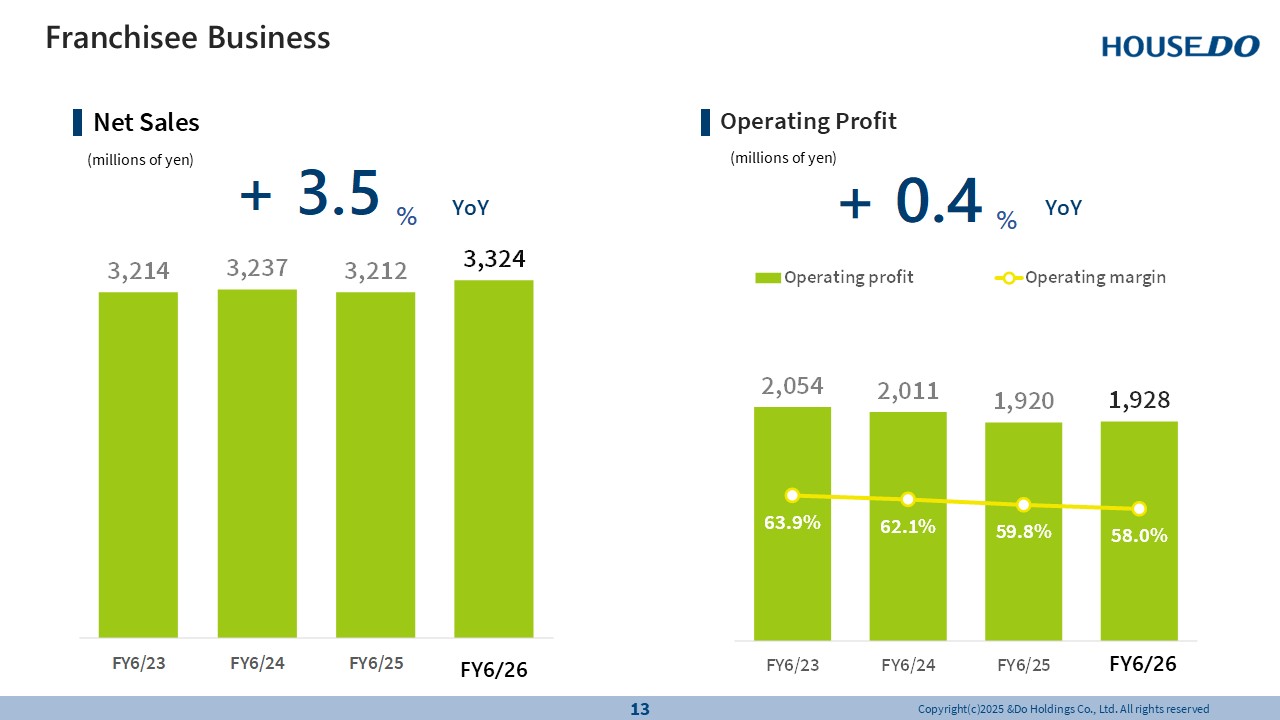
Franchisee Business
[Tominaga:President]I will now explain the other segments.
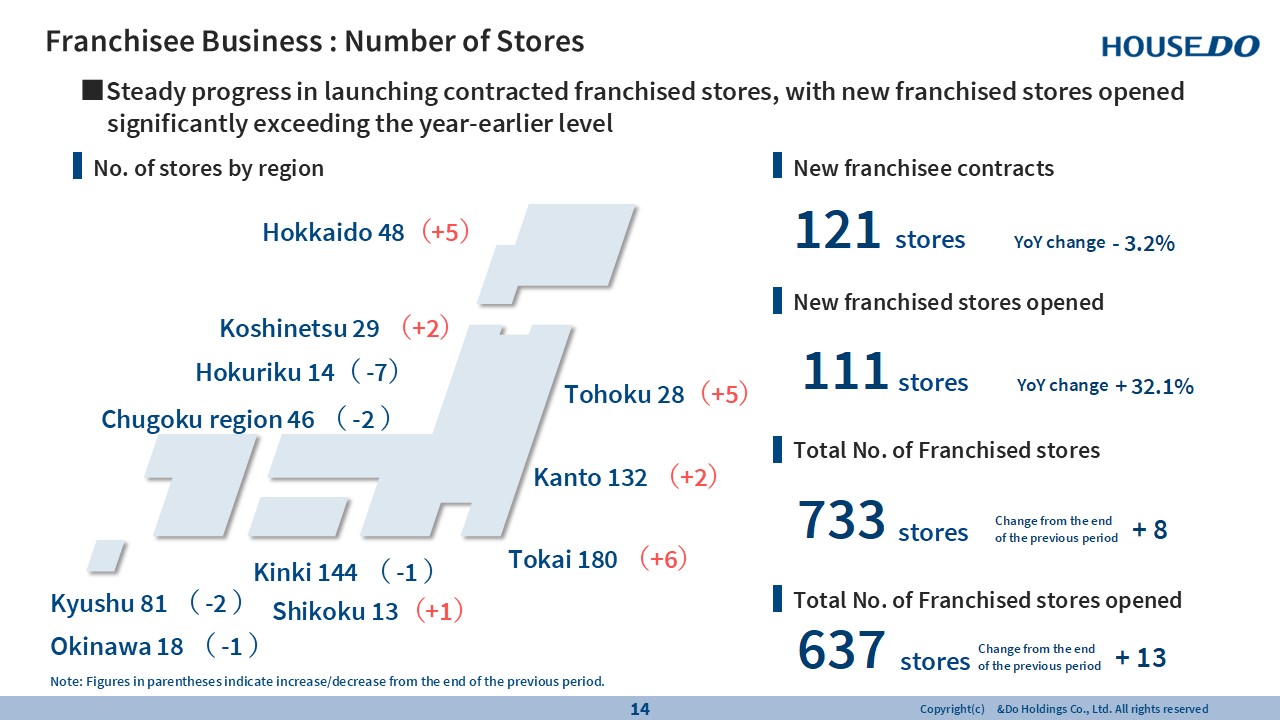
First is the Franchisee Business. Net sales increased by 3.5% year on year to 3,300 million yen. Operating profit increased slightly, rising 0.4% to 1,920 million yen. I will now briefly explain these recent results.
-
Franchisee Business : Number of Stores
One metric to which we attach particular importance is the number of new store openings, which reached 111. This represented a year-on-year increase of 32.1%. A major factor was the increase in personnel providing support to franchisees, which ultimately produced significant results. The cumulative number of franchise stores increased by eight year on year to 733. -
Real Estate Buying and Selling Business (Excluding the former Real Estate Brokerage Business )
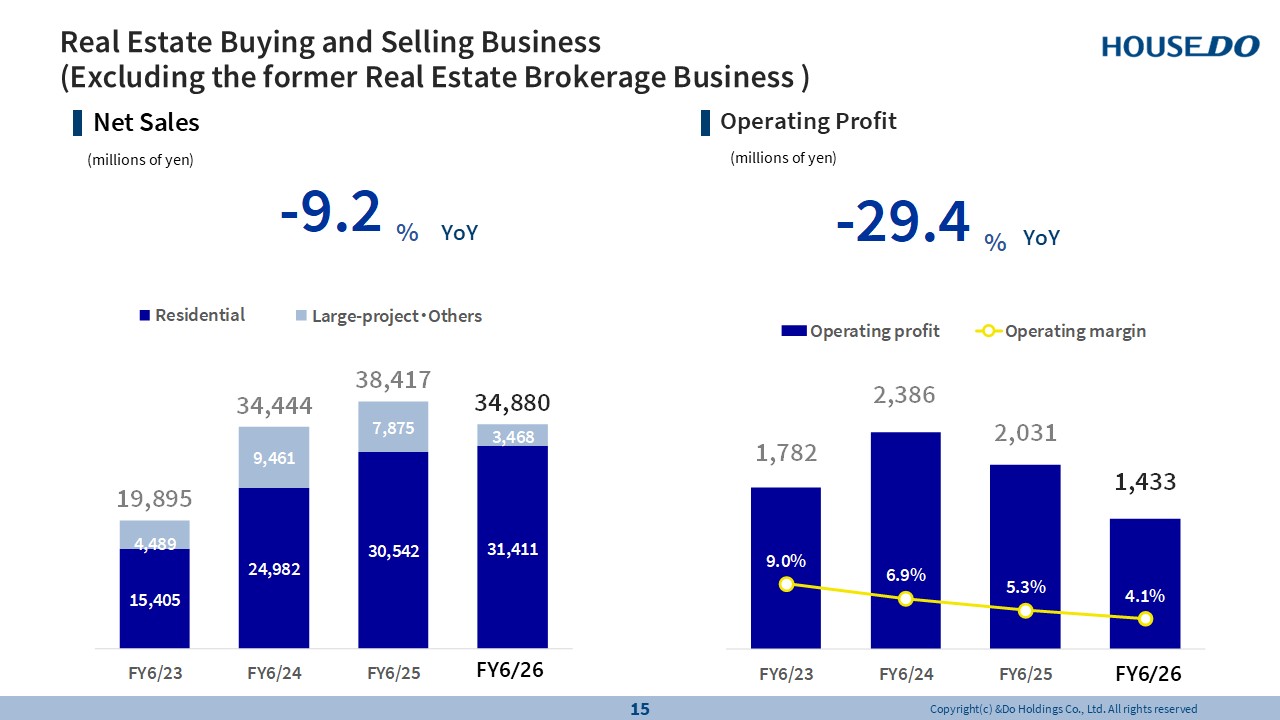
In the Real Estate Buying and Selling Business, net sales decreased by 9.2% year on year. Looking at the breakdown, net sales from residential properties increased slightly, while net sales from large-scale properties decreased due to the timing of some transactions shifting to another period, as explained earlier.
Operating profit decreased by 29.4% year on year. The main factors were our decision to invest in personnel and the timing of sales of some large properties shifting to another period.
-
Real Estate Buying and Selling Business: Summary
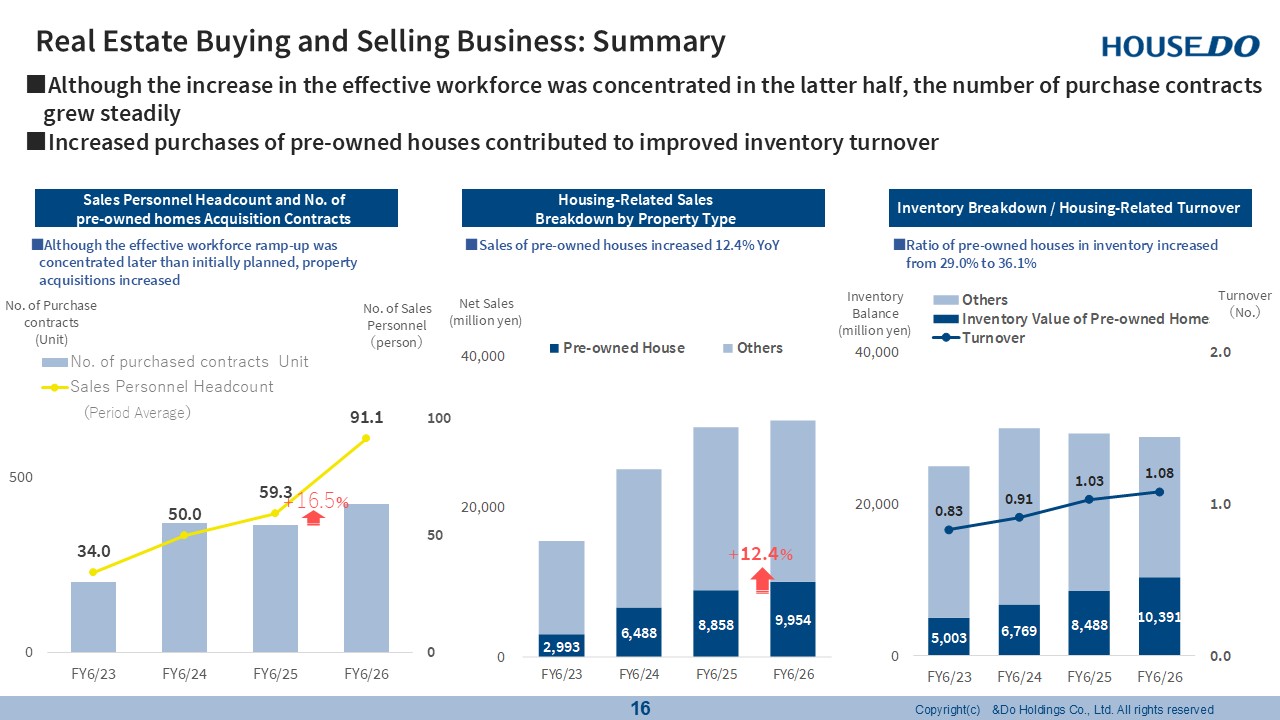
I will now explain the detailed figures. First, we significantly increased personnel during the fiscal year under review. Compared with the average number of personnel during the previous fiscal year, the average for the current fiscal year increased by approximately 30. This investment was one factor behind the increase in selling, general and administrative expenses.
Net sales from residential properties increased by 12.4%. As we have explained, over the past two to three years, we have been shifting toward pre-owned homes, and the results of this shift are now becoming evident. With this shift, and reflecting the faster turnover characteristic of pre-owned homes, inventory turnover has improved for four consecutive fiscal years, as shown here.
-
Inventory Holding Period in the Real Estate Buying and Selling Business [Percentage of Properties]
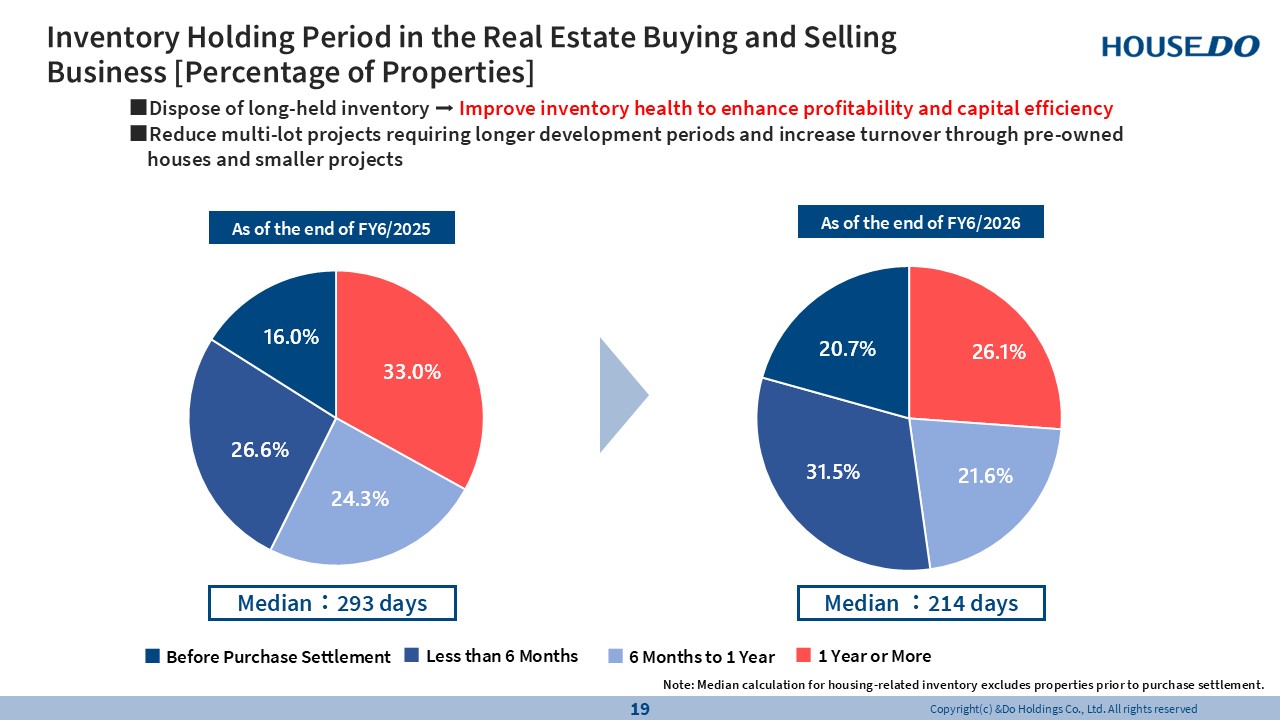
Furthermore, as Tomita mentioned earlier, this illustrates the improvement in inventory turnover. The figures on the left are as of the end of the fiscal year ended June 2025. Inventory held for more than one year accounted for 33%, and we sought to improve this substantially. As a result, the figure improved considerably to 26.1% at the end of the fiscal year under review. -
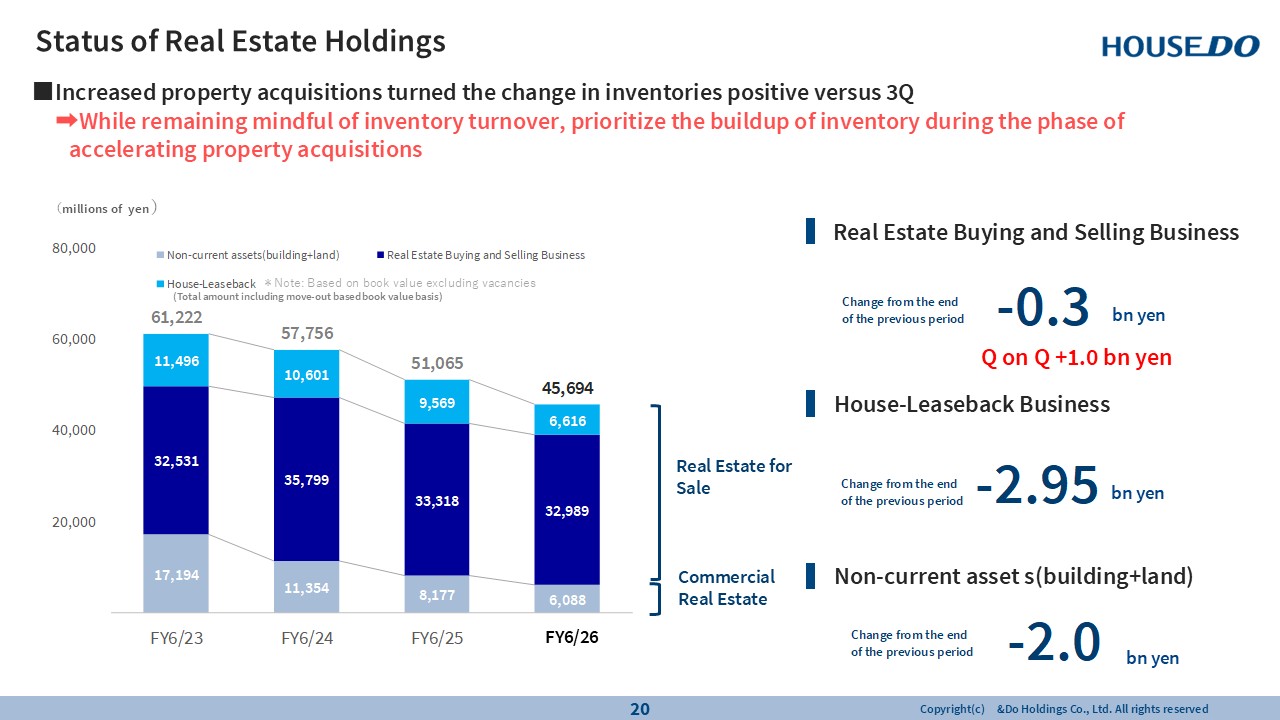
Status of Real Estate Holdings
I will now explain the current status of our real estate holdings. First, real estate holdings in the Real Estate Buying and Selling Business decreased by 320 million yen from the end of the previous fiscal year. Although this represents a decrease on a fiscal year-end basis, holdings increased by 1,090 million yen in Q4 alone. We believe this reflected the results of our decision to increase personnel. -
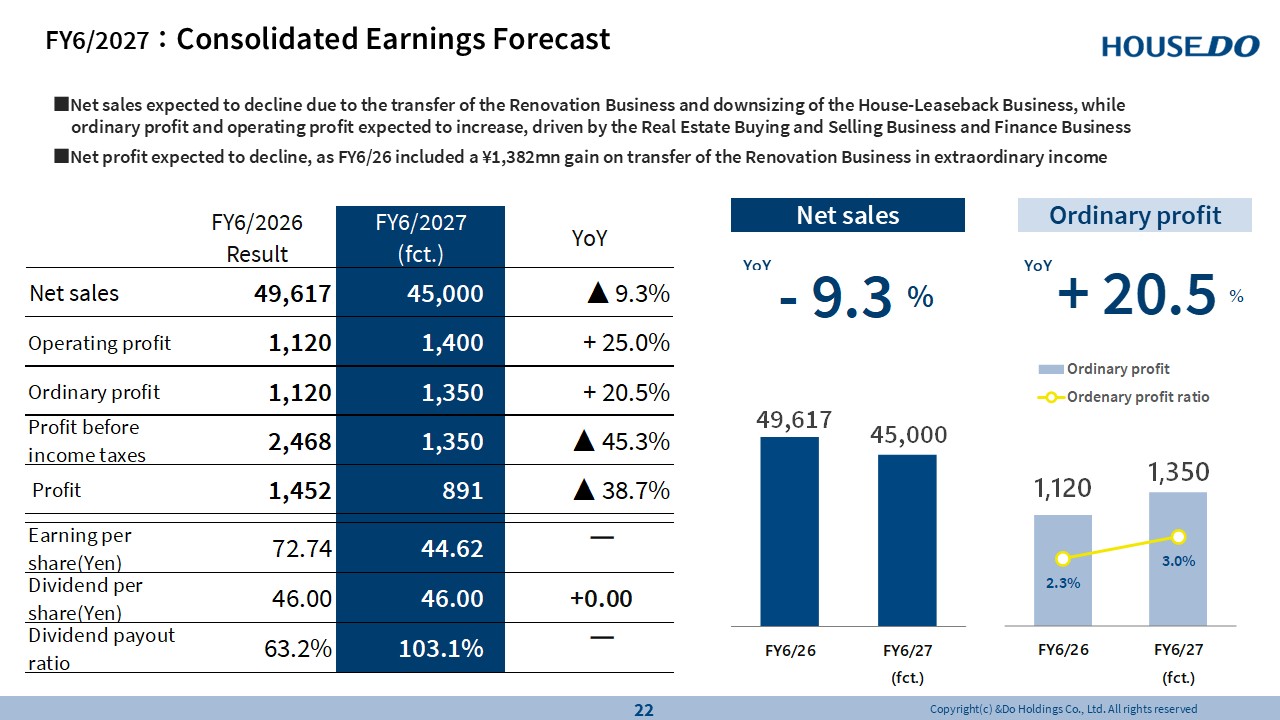
FY6/2027:Consolidated Earnings Forecast
I will now explain our plan for the current fiscal year. We forecast a decline in net sales due to the transfer of the Renovation Business and the scaling down of the House-Leaseback Business. We expect operating profit and ordinary profit to increase, driven by the Real Estate Buying and Selling Business and Finance Business. We plan for net sales to decrease by 9.3% and ordinary profit to increase by 20.5%. -
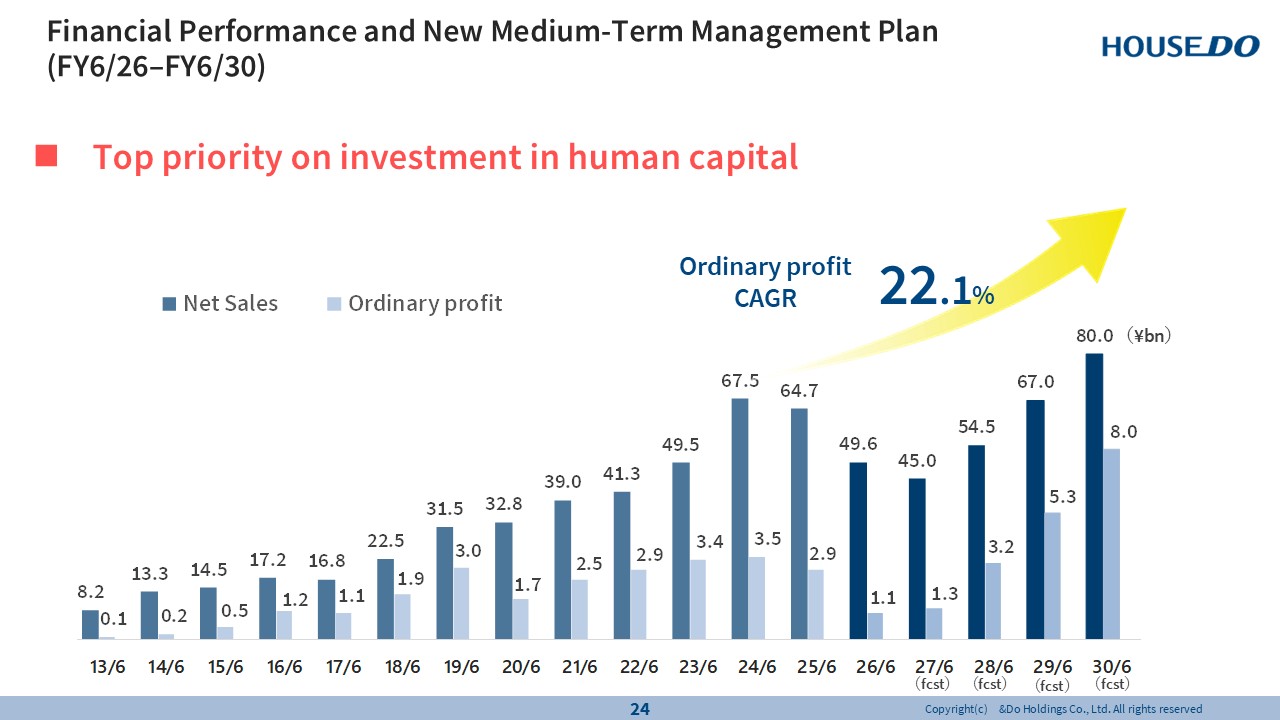
New Medium-Term Management Plan (FY6/26?FY6/30)
[Ando, Chairman&CEO] Finally, I will discuss the medium-term management plan.
As announced, we have set targets of 80 billion yen in net sales and 8 billion yen in ordinary profit for FY6/2030. However, the results for the previous fiscal year and the plan for the current fiscal year are below the initial targets.
However, as we have been successful in recruiting new personnel, we intend to leverage this workforce to drive growth over the next five years. The previous and current fiscal years are periods for training and developing these new hires. As this requires a lead time of approximately one year, we intend to complete this process and steadily improve our results.
-
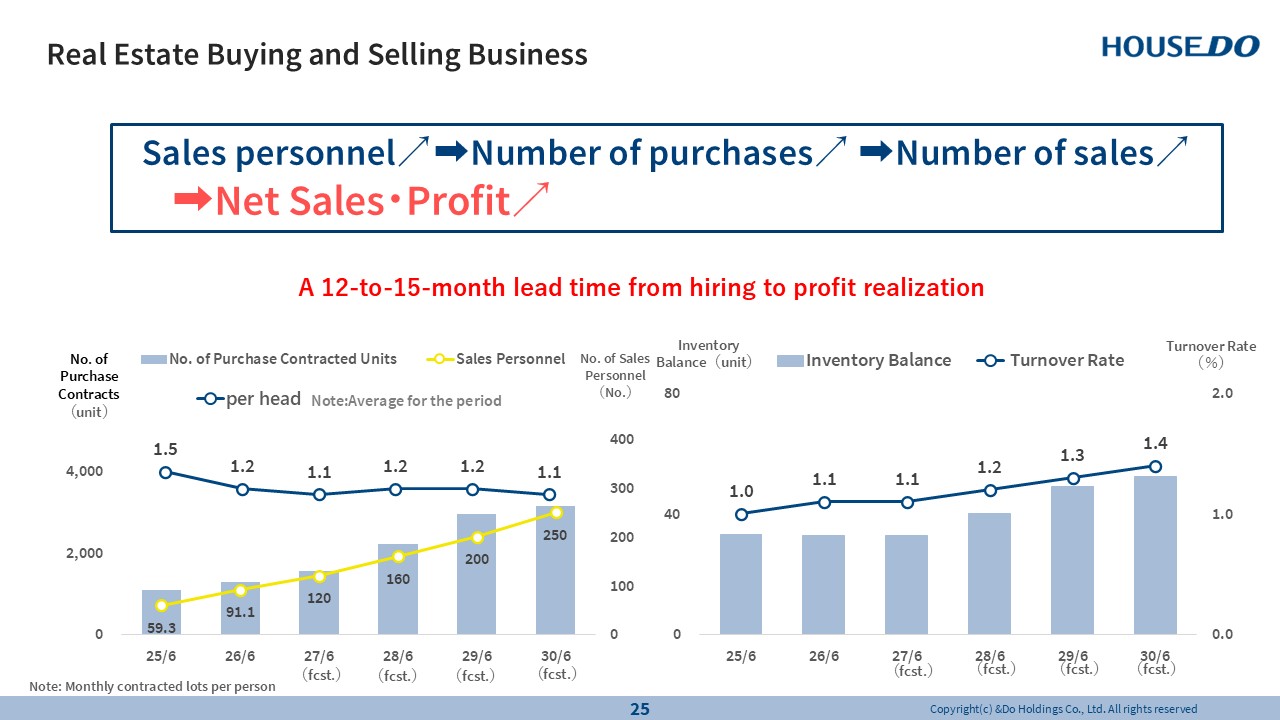
Real Estate Buying and Selling Business
As shown in this graph, the earnings model for pre-owned homes in the Real Estate Buying and Selling Business is straightforward: increasing the number of sales personnel leads to more property acquisitions, followed by more property sales and, ultimately, higher net sales and profit. The key, therefore, is how effectively we can recruit personnel. Fortunately, we are seeing a very encouraging response in the recruitment market. We increasingly feel that the recruitment environment is providing us with a strong tailwind, as the number of applications continues to grow rapidly.
This is represented by the yellow line. The yellow line shows the increase in the number of sales personnel, which we are continuing to expand. This leads to an increase in the number of properties acquired. These acquired properties are subsequently sold, generating net sales and profit.
A lead time of approximately one year to one year and three months is required from recruitment until profit is realized. We initially expected sales personnel from the Real Estate Brokerage Business to drive growth in FY6/2025 and FY6/2026, but this contribution did not materialize. Growth will therefore be driven by new hires from FY6/2027 onward, accompanied by increases in property acquisitions and inventories. As we continue recruiting, acquisitions and inventories will increase, ultimately generating profit. Accordingly, business volume will build as we approach FY6/2030, and we ask that you closely monitor this progress.
Increasing the number of hires, particularly sales personnel, is the key to expanding business volume. Fortunately, conditions in the pre-owned housing market are providing a strong tailwind.
We are particularly strong in regional markets, where we target properties in attractive locations and turn them over quickly. Pre-owned homes can be turned over in half the time required for newly built homes. We are confident that rising interest rates will strengthen sales of pre-owned homes, and we intend to focus on this area and expand our market share.
Although we have revised our forecasts downward this time, we intend to narrow our focus and concentrate firmly on these areas. Thank you.